

developer_mh
-
Posts
1,860 -
Joined
-
Last visited
-
Days Won
173
Everything posted by developer_mh
-

Speichern von Screenshots und Reports - von PVSol vorgeschlagener Speicherort
developer_mh replied to Ralf's topic in PV*SOL
Hallo Ralf, es tut mir leid zu hören, dass die Ordnerwahl bei dir so verrückt spielt. Ich es habe versucht, bei mir nachzustellen, aber bei mir wird immer das Installationsverzeichnis PV*SOL premium standardmäßig geöffnet. Warum sich der Meteonorm-Ordner öffnet, ist mir ein Rätsel. Könntest du mir mal die ini-Datei schicken, die du unter "C:\Users\<USERNAME>\Documents\Valentin EnergieSoftware\PVSOL premium 2021\PVSOL.ini" findest. Aber bitte als private Nachricht hier im Forum. Dass sich am besten der zuletzt ausgewählte Ordner gemerkt werden sollte, stimmt aber natürlich. Das werde ich weitergeben, bzw. auf die Liste setzen. Danke für den Hinweis. Beste Grüße und einen guten Start in die Woche, Martin -
Hi keirm, did you try to apply this work-around here: This should be fixed in the new release, PV*SOL premium 2021 R3. Could you provide a screenshot, please? Also, does this behaviour disappear when you apply the above mentioned work-around? Hope that helps, kind regards, Martin
-
Hi Chris, the electricity savings are calculated with the energy that you don't have to draw from the grid (because you have a PV system now), multiplied with the costs of electricity from grid (in €/kWh), which is defined in the from-grid tarriffs, as Vishnu correctly pointed out. Let's say you have a consumption of 5000 kWh per year. Usually you pay 0,25 €/kWh to the electricity company, that is 1250 € per year. Now with your PV system you can use 1500 kWh of your produced solar energy directly to cover your consumption, so you only have to cover the rest of 3500 kWh from the grid. For those 1500 kWh you don't have to pay your electricity provider, so you save 1500 kWh * 0,25 €/kWh = 375 €. Hope that clarifies the matter, kind regards, Martin
-
Hi Josef, Usually the runtime should install itself during the PV*SOL installation, but sometimes this fails. You can install a newer version of the .NET framework, at least version 4.7.2., by hand. Visit the following link, download the runtime and install it on your machine. https://dotnet.microsoft.com/download/dotnet-framework/net472 Choose to install the runtime, not the developer pack. Kind regards, Martin
-
Dear Petros, we do have that feature on our list, but right now I can't tell a date. It is not scheduled yet, I am sorry. But there are plenty of tracking options (backtracking modes included) in the main application. https://help.valentin-software.com/pvsol/2021/en/pages/pv-modules/#tracking Kind regards, Martin
-
HI Bert, thanks for the project files. What you see there as "hourly discontinuities" is the effect of hourly calculated shadows from the 3D environment. That is, they are calculated on a 10 min basis, but then averaged to 1h values prior to handing them over to the main PV*SOL application for performance reasons. One can see that the phenomenon is not visible until the module specific shading (and low light behaviour, which is of course dependent) come into play: And then: So, no error here, just hourly shading values. In future we want to be able to use 1min values of the shading as well, but this requires much more performance (factor 60), so unfortunately this is not so easy to accomplish. Hope that helps, kind regards, Martin
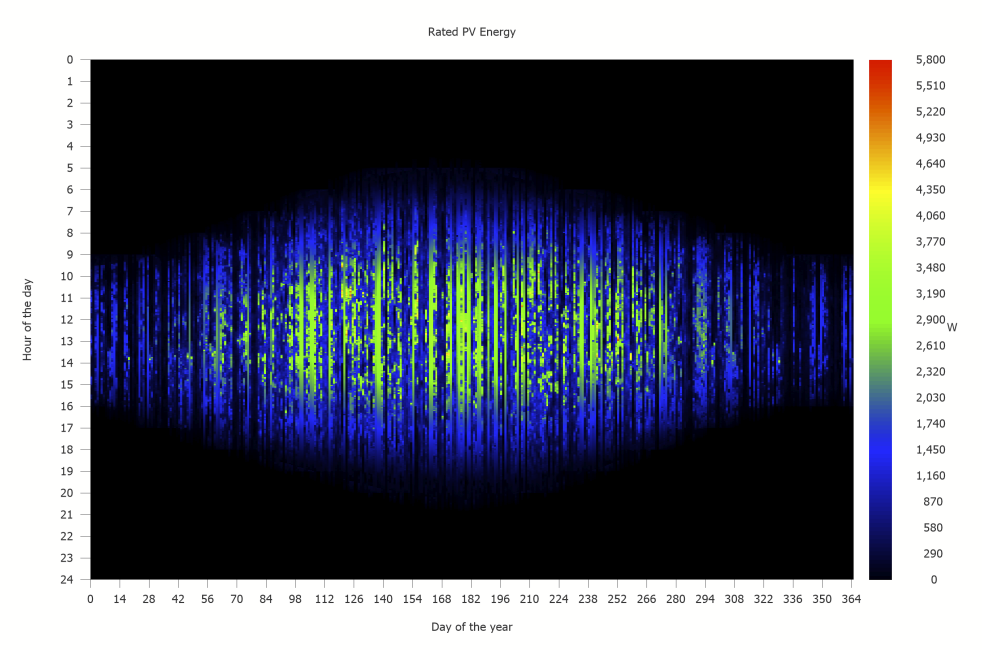
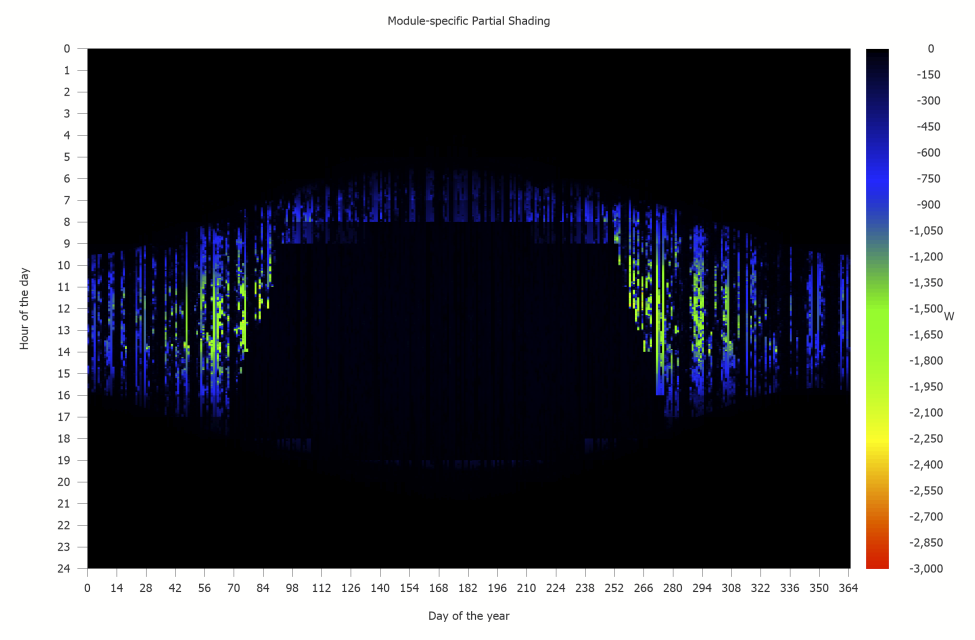
-
Hi Bert, thank you for the question. Could you provide a project file, please? You can send it here in the forum by private message (to me). Or by email to hotline@valentin-software.com, with a short note that they shall forward it to me. Kind regards, Martin
-
Hi V Solar, in PV*SOL you can only place modules on plane (i.e. not round) surfaces. For this reason you have to create the cylindrical shape out of approximations with plane sections. See this post here for some hints. I guess you want to place the PV modules on top of the oil tank? You would then have to create the dome out of small triangles (in Sketchup for example), like a geodesic polyhedron (http://www.wikiwand.com/en/Geodesic_polyhedron) PV panels on top of oil tanks... I like the picture there Kind regards, Martin
-
Hallo Spap, hast du die Kosten für das Batteriesystem in den Wirtschaftlichkeitsparametern eingegeben? Auf der Seite Wirtschaftlichkeit -> Parameter zur Wirtschaftlichkeit -> Bearbeiten -> Kostenbilanz kannst du sie eintragen. Beste Grüße, Martin
-
Hi Barbadori, PV*SOL doesn't show something like this out of the box, no, sorry. You would have to export the simulation results to a spreadsheet application (e.g. Excel) and craft it yourself, I guess. Kind regards, Martin
-
Hello John, although it warms my heart to see a screenshot of PV*SOL expert, which is about six years old, I would recommend to use the current version of our software, PV*SOL premium 2021. We can't provide support for Expert anymore, I am afraid. https://valentin-software.com/en/downloads/ Kind regards, Martin
-
Hi Keir, right now there is no other possiblity than to modify the values beforehand in a text editor or Excel or so, i.e. cut the values from line 1 to 5856 (01/09/19 00:00 to 31/12/19 23:30) and put them at the end of the file. But I will put this request on our list, it should be no problem to implement it. Kind regards, Martin
-
Hallo loho, nein, diese Kombination geht in PV*SOL tatsächlich nicht. Eine Möglichkeit, die mir jetzt so spontan einfällt, wäre, das Ladeprofil des E-Autos aus den Ergebnissen einer netzgekoppelten Anlage zu extrahieren und als Lastprofil in einem netzautarken Projekt zu importieren. Beste Grüße und viel Erfolg bei der Projektarbeit! Martin
-
Hi Tim, does this happen all the time or only after you do something special (like search coordinates, for example). As a side note: it is best to use the semicolon if you search for coordinates, not the comma, to separate latitude and longitude. Kind regards, Martin
-
Hi Jordn, yes, this is true. This is often the case when we switch to new major versions, as we often have to change something in the internal structure of the project file. Kind regards, Martin
-
Dear Tomasz, we don't have the modules in our database yet, but I will inform our database team. Just to be sure, you refer to those modules here: https://www.solaredge.com/products/smart-solar-modules#/ In the meanwhile, you can also try to enter the module yourself. All necessary data should be on the datasheet (except for the low light behaviour, there you can just select 'standard'). https://help.valentin-software.com/pvsol/2021/en/databases/components/pv-modules/ Kind regards, Martin
-
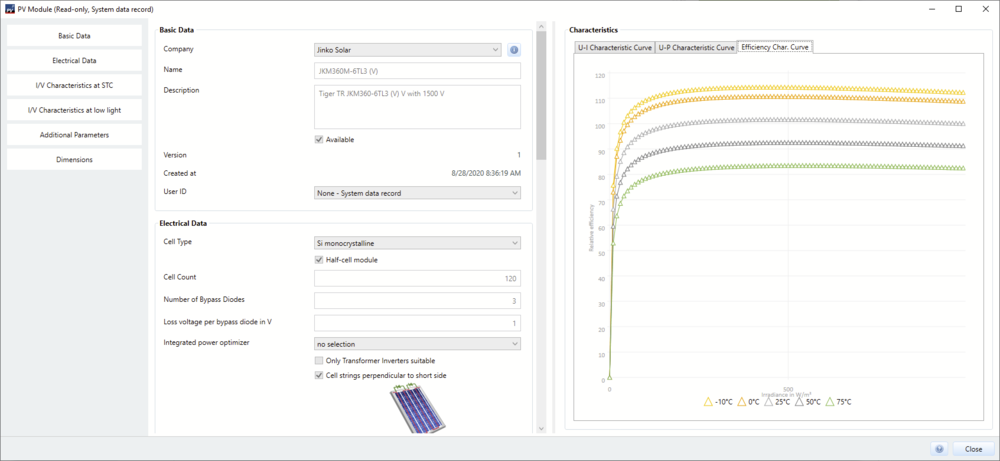
Dear Berend, yes, this is possible. It depends on the module characteristics and the distribution of irradiance intensities. This module (used in the project that you sent to our hotline, thanks for that) has a positive relative efficiency in the irradiance range between 200 and 1000 W/m² (light grey curve is slightly above 100%). In relative terms, the module is therefore a little more efficient in the range of 200 to just under 1000 W/m² than under STC conditions; only below 200 W/m² does the relative efficiency drop. With such modules, you can often see a positive effect of the low light behaviour. Kind regards, Martin
-
Hallo Bene-Solar, ja, das wäre gut, danke. Gerne hier im Forum per privater Nachricht. Viele Grüße, Martin
-
Hallo Mart, ja, das ist derzeit so, die Strahlung auf die Modulvorderseite wird ausdifferenziert in den direkten und diffusen Anteil, die Strahlung auf die Modulrückseite hingegen nicht. Intern rechnen wir zwar genau so mit dem direkten und dem diffusen Anteil, aber es wird derzeit nicht gesondert ausgegeben. Bei vertikal aufgeständerten Modulen kannst du aber davon ausgehen, dass der Diffusanteil auf der Rückseite bei vergleichbarem Sonnenstand und ähnlicher Globalstrahlung etwa gleich ist. Den Bifazialitätsfaktor musst da noch nicht mit einbeziehen, der beschreibt ja nur, wieviel Prozent der auf der Rückseite auftreffenden Strahlung dann überhaupt verarbeitet werden kann. "Verluste durch Bodenreflexion" - dass da noch Verluste steht, ist ein Fehler, sorry. Bei der zusammenfassenden Energiebilanz ist einfach von "Bodenreflexion (Albedo)" die Rede, es handelt sich hierbei ja um Gewinne. Beste Grüße, Martin
-
Hallo Ralf, das ist ein bekanntes Problem, das wir leider im 3D-Programm-Teil nicht richtig in den Griff bekommen. Es hängt mit der Bildschirm-Skalierung zusammen, die es jetzt immer häufiger gibt, da die Bildschirme immer höher aufgelöst sind. Eine Lösung wäre, die Bildschirm-Skalierung auf 100% zu stellen. Wenn dann aber alles so klein ist, dass es nicht mehr lesbar ist, helfen vielleicht folgende Tricks: Beste Grüße, Martin
-
Hallo Philipp, nein, diese Option, also ein reines PV-Diesel-System, oder sogar ein reines PV-System ohne zusätzliche Energie-Quelle, ist leider noch nicht verfügbar in PV*SOL. Beste Grüße, Martin
-
Hallo Art, wenn sich deine Frage auf die Situation nach Zusammenlegung der Zähler bezieht: Ja, das kann man so ein PV*SOL machen, es gibt ja dann keinen zählerischen Unterschied zwischen den Verbrauchern aus dem Eltern- und Sohn-Haushalt. Wenn sich deine Frage darauf bezieht, ob man auch den Übergang darstellen kann, also die vorherige und die Situation danach, zusammen in einem Projekt, dann lautet die Antwort leider: Nein. Viele Grüße, Martin
-
Hi Ricardo, in situations where you want to create a database product that is not officially available, I would recommend to start with a copy of an existing product of the same manufacturer that is as close as possible to the product you want to enter. For example, from the same product line or so. In this case here, candidates are the SUN2000-36KTL and the SUN2000-50KTL. I would suggest that you take the missing values of the MPP efficiency from them. They are a bit different though, but most of the times, also in other Huawei inverters, the values 99.8 and 99.95% seem to prevail. Kind regards, Martin
-
Hi Jimmy, Ja, you wouldn't believe the multitude of errors that you can have when programming Windows applications. It is like fighting against wind mills But anyways, the important thing is that we can identify the errors quickly and provide bugfix updates. This is really one unlikely bug. It is built deeply into the GUI components of WPF (the GUI element framework that is used for this dialog), but only affects this dropdown list for high DPI monitor scaling settings. But I guess we found a work-around for that. We will release it with R3 of PV*SOL premium 2021. Thanks for your feedback, kind regards, Martin
-
Hallo, die Datenblätter, die dem Bericht hinzugefügt werden, sind nicht die originalen Datenblätter der HErsteller, sondern sozusagen eine Auflistung der Parameter, die bei uns aus der Datenbank kommen (in der Regel durch die Hersteller eingegeben). Insofern muss man da auch nichts selbst hinzufügen. Viele sonnige Grüße zurück, Martin
- 1 reply
-
- 1
-